Michael Angelo Batio (pronounced /ˈbeɪtioʊ/, also known as Mike Batio or MAB) (born in 1956) is an American guitarist and columnist from Chicago, Illinois. Considered to be one of the fastest guitarists in the world, Batio was voted the "No. 1 Shredder of All Time" by Guitar One Magazine in 2003. He was also listed as one of the "Top 100 Greatest Metal Guitarists of All Time" by Guitar World Magazine, whom he writes the column Time to Burn for, and one of the "20 Greatest Shredders of All Time" by Total Guitar Magazine, both in April 2008.
Early years
MAB started playing the piano and composing music at the age of five, and first played guitar at the age of ten, reportedly playing faster than his teacher within two years. At the age of fourteen he started playing jazz guitar, and within two years he had won the Chicago-based "All-State Jazz Solo Award". He attended Northeastern Illinois University and achieved a Bachelor of Arts degree in Music Theory and Composition. After he had graduated, Batio looked to become a session guitarist in his hometown. When he asked for a job at a nearby studio, he was given a piece of music and simply asked to play it. Naturally, he managed to play it and added in some of his own improvisations and fills, making him the studio's primary call-out guitarist. As a session player, Batio recorded music for such companies as Burger King, Pizza Hut, Taco Bell, KFC, United Airlines, United Way, McDonalds, Beatrice Corp. and the Chicago Wolves hockey team.
Holland (1984–1986)
Batio began his recording career in 1984 when he joined new Chicago-based heavy metal band Holland, an eponymous project set up by ex-Steppenwolf singer Tommy Holland. With major label Atlantic Records, the band released their debut studio album in 1985 entitled Little Monsters, which saw moderate success in the United States. The band split up soon after, and a compilation of material from the Little Monsters sessions, Wake Up the Neighbourhood, was released in 1999 through Batio's label M.A.C.E. Music.
The Michael Angelo Band (1986–1987)
After the breakup of Holland, Batio started his own eponymous band with singer Michael Cordet, bassist Allen Hearn and drummer Paul Cammarata. The Band did not release any albums, though three of their songs appeared on the 1998 Nitro compilation Gunnin' for Glory.
Nitro (1987–1993)
In 1987 Batio joined glam metal artist Jim Gillette on his solo album Proud to Be Loud, before founding the band Nitro with bassist T.J. Racer and drummer Bobby Rock. In 1989 Nitro released their first studio album, O.F.R., from which they released two singles, "Freight Train" and "Long Way From Home". The music video for "Freight Train", which received much airplay on MTV, was notable for featuring Batio playing his now famous 'Quad Guitar', a notion which FHM Magazine voted one of the "50 most outrageous moments in rock history"
By 1992, Rock and Racer had been replaced by Johnny Thunder and Ralph Carter respectively, and it was in this year that they released their second studio album entitled Nitro II: H.W.D.W.S.. Included on the album was a cover of Ted Nugent's "Cat Scratch Fever", which the band also recorded a music video for. Nitro disbanded shortly afterwards.
Solo (1993–present)
In April 1993, Batio founded his own record label, M.A.C.E. Music, which became one of the first labels online in 1996. He used this label when he began recording his first album, No Boundaries, which he released in 1995. Batio's second studio release was Planet Gemini in 1997, which showed a very progressive, experimental side to his playing. In 1999, Batio released his first instructional video, Jam With Angelo, which came with his third studio album as a companion CD: Tradition. This was quickly followed by a fourth full-length album in 2000, Lucid Intervals and Moments of Clarity, which was credited to "Mike Batio and Rob Ross", the latter being the drummer. In 2003, Batio released his first DVD, the title release in his Speed Kills series, followed by the second, Speed Lives, in 2004. It was also in this year that Batio released a compilation album, Lucid Intervals and Moments of Clarity Part 2, which featured songs from Tradition and Lucid Intervals.
In 2005, Michael released his highly anticipated cover/tribute/studio album, Hands Without Shadows, which featured guest appearances from such musicians as Mark Tremonti (of Alter Bridge fame), Rudy Sarzo (of Ozzy Osbourne, Quiet Riot, Whitesnake and Dio fame) and virtuoso newcomer Bill Peck. In 2006, DVD Speed Kills 2 was released, in addition to the first in the new Hands Without Shadows series, Performance. Batio's latest release came in 2007, when his first two albums - No Boundaries and Planet Gemini - were remixed and remastered with additional drums, for an album entitled 2 X Again; the title of a song from the first album. Angelo also released three DVDs in 2007: Speed Kills 3, 25 Jazz Progressions and MAB Jam Session.
Two DVDs are slated for a 2008 release, one that focuses on neo-classical techniques and concepts and another which will contain Batio's live performance at the Simi Valley Cultural Arts Center on July 9.[10] One of these DVDs is apparently to be entitled The Neoclassical Power Approach, according to the flyer for the aforementioned concert.
Style
Batio is (self-taught) ambidextrous, able to play two guitars at the same time either in synchronization or using separate harmonies, as shown when he plays his famous Double-Guitar. Though naturally left-handed, he plays as a right-handed person when playing one guitar. Batio mastered the "Over-Under" technique, which involves flipping his fretting hand over and under the neck, playing the guitar both regularly and like a piano.
Batio taught guitarist Tom Morello (of Rage Against the Machine and Audioslave fame) while at college. Morello has credited MAB with teaching him in a feature article in Guitar World Magazine in 2005. Michael also gave lessons to guitarist Mark Tremonti after Creed broke up and Tremonti wanted to learn more techniques.
Equipment
Guitars
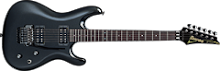
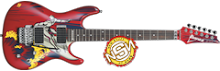
Batio is an exclusive user of Dean Guitars, both electric and acoustic. In 2007 he designed and developed a signature guitar with Dean, known as the MAB1 Armorflame.
[edit] The Double-Guitar
Batio was the inventor of the Double-Guitar, a V-shaped, twin-neck guitar which can be played both right- and left-handed.[13] The first version of this instrument was actually two separate guitars simply played together, as opposed to being one entity. A Flying V was fastened to a snare drum in a left-handed position, while another one was strapped around his shoulder. The next version of the guitar, as designed by Batio and guitar technician Kenny Breit, featured a flight case latch attached to the back of each guitar, which could reportedly be assembled in five seconds. In October 2003, Dean designed and built the "Mach 7 Jet", and on March 6, 2007, the newest version was delivered to Batio. The original Double went on display at the Chicago Hard Rock Cafe 'wall of fame' before it was relocated to a HRC in Egypt. Its whereabouts are currently unknown.
When the Double-Guitar was first used in concert, Batio noticed that the guitars created a lot of feedback when played together. He decided that he needed to invent a way to 'dampen' the strings when both guitars were played at the same time, hence the invention of the "MAB String Dampener", which is now available to buy from M.A.C.E. Music.
The Double-Guitar was recently named as the 8th "coolest guitar in rock" by online music magazine Gigwise.
The Quad Guitar
As well as the Double Guitar, Michael Angelo also invented and designed the Quad Guitar. The guitar was originally built in conjunction with Gibson, and built by Wayne Charvel in California. The top two guitars have seven strings, while the bottom two have the regular six. The first Quad, as used in the video for Nitro's "Freight Train", was stolen in El Paso, Texas after the second show of Nitro's O.F.R. tour. When Batio was performing in November 2004, a young fan named Simon Jones and his father turned up with a guitar case which held inside the two top guitars of the Quad, as found by Mick Seymour. Dean designed and built a new Quad Guitar in 2007.
The Quad Guitar was recently named as the 2nd "coolest guitar in rock" by online music magazine Gigwise.
Effects
Batio's effects pedals are exclusively made by T-Rex, with whom he has also developed a signature model, the "MAB Overdrive".[18] In his years with Nitro, Batio used Boss overdrive (DS-1, SD-1) pedals.
In the studio, Michael also uses the following effects pedals:
- Eventide Eclipse
- Rocktron Intellifex
- Rocktron Replifex
- Dunlop Cry Baby
- Vintage original prototype Digitech Whammy
- Vintage Digitech 256 multi-FX
- Morley Wah Pedal
Pickups
Another signature piece of equipment Batio developed is the "MAB Hands Without Shadows" pickup, which he uses in his Double Guitar when touring. The pickup is specially designed for shred guitar, and provides the clean tone Batio is accustomed to. The Armorflame, Batio's signature guitar, uses EMG 81, 85 and SA pickups.
Earlier on in his career when he was first endorsed by Dean guitars he also embraced Dean's tradition of popularising Dimarzio pickups and had used Dimarzios in his guitars. These include the Dimarzio PAF, Super Distortion (sometimes using the Super Distortion both in the neck and bridge position, like how he did in his Gibson Charvel Circuit Board double guitar. This was the main setup during the recording of No Boundaries). Batio has also used pickups of other brands including Seymour Duncan, namely the Pearly Gates and JB models and also Bill Lawrence pickups. Currently other than using EMGs in his signature guitar he also has a collection of the other brand pickups in his Dean limited edition collectors' models, such as Dimarzio Custom Super Distortions (based on the Super 2 and Super Distortion) in his USA Dean Time capsule Blue Burst ML and the Seymour Duncan pair he used (refer to above) in his USA Dean Collectors edition Hardtail.
Strings
Batio uses Ernie Ball guitar strings, favouring the .009 to .042 models for soloing and most rhythm guitar parts while thicker gauge strings are used for detuned guitars. The acoustic gauge is normally .010 to .046 or .011 to .052.
Michael uses black Dunlop Jazz IIIs as his guitar pick of choice, and has used the 'teardop' shape of pick since he first started playing. Different picks are sometimes used for acoustic work.
Amplifiers
Batio typically uses Marshall JCM 2000 amps on tour and for newer studio records. In the studio, he also uses the Marshall JMP-1 preamp and Rocktron Chameleon and Voodoo Valve preamps. During his years with Nitro, Batio used Randall amplifiers. He has been an avid Marshall amp user throughout his career and has used the JCM 800 (mostly Jose Arrendondo modified circuitry, very early in his career) and JCM 900 (especially when recording No Boundaries).
Cabinets
Batio's cabinet setup consists of 4x12 Marshall cabinets loaded with Celeston vintage 30s and Greenbacks in mono and stereo.
Read More......


 While in junior high school (age 15), SLASH's grandmother gave him his first guitar. Although it had just one string, SLASH was able to learn to play. SLASH's early musical influences were Led Zep, Eric Clapton, the Rolling Stones, Aerosmith,Jimi Hendrix, Jeff Beck, Neil Young. He credits the Aerosmith album ROCKS with changing his life. Getting to play with the musical idols of his life means a lot to him. Standing on a stage in Paris with Jeff Beck and Joe Perry was overwhelming. SLASH also has gotten to play with guitarist "god" Eric Clapton. He has played with many other artists including Lenny Kravitz, Paul Rogers, Iggy Pop, Michael Jackson, Brian May to name just a few.

 In the summer of 1996, SLASH was invited to play at a blues concert in Budapest, Hungary. He got together some musicians and headed for Europe. From this beginning came a terrific band called SLASH's Blues Ball. And though this band never recorded an album, it was in big demand by promoters and fans.
  SLASH didn't sit at home with his head in his hands. He got busy with Blues Ball! Blues Ball played blues covers, so they could start playing gigs right away. Throughout the end of 1996 till the fall of 1997, SLASH's Blues Ball played at clubs throughout California, into the southwest and the northeast. Blues Ball has rolled away for the time being but may play some one-offs. You just never know with SLASH!
 When SLASH left Guns N'Roses, his many fans wondered what he might be going do with all that talent and personality. The media were wondering, too. At first, there was speculation that the Axl - SLASH rift would be of short duration and a reconciliation was inevitable. SLASH had been quoted as saying that when Axl Rose was ready to make a rock and roll album, he would be back. As Rose filled GNR with hired guns and unknowns, SLASH made it clear that Snakepit will be his permanent band. He says he could do a one off or a short tour with the original band, but he would never walk on stage with a band pretending to be the Guns N'Roses band.
 As promised, SLASH brought back Snakepit! He had 300 demo tapes from musicians who wanted to be in his band. He settled on drummer Matt Laug (formerly with Venice) and bassist Johnny Griparic (formerly with SLASH's Blues Ball). Rhythm guitarist was at first Ryan Roxie. Ryan was in Dad's Porno Magazine and Alice Cooper's band. Ryan did the pre-album tour and the recording, but then decided to stick with his many other bands. SLASH was able to enlist the wonderful Keri Kelli as the band's second guitarist. Snakepit's vocalist is a newcomer, Rod Jackson, from Virginia and the band Ragdoll there. The new album was released October 10, 2000 in the US with the upbeat title Ain't Life Grand. Elsewhere in this website, you will find some song clips, lyrics and reviews. SLASH's Snakepit began their tour by opening for AC/DC on the North American leg of their tour. This gave the band huge exposure. The band toured the Far East with great results and and then did a European tour in December. In February 2001, the 'pit launched a club show in the US. The tour did very well, but on March 11, SLASH came down with the flu and the rest of this tour was cancelled. The band was also to open for AC/DC again in March in the US until SLASH's flu turned into pneumonia. It's hard to imagine this dynamo stopped by illness, and he won't be for long. May 2001 finds SLASH recuperating and planning the next leg of the tour. Snakepit gave its last performance in July 2001. The band went home for some rest before recording the next album. The rest time was getting long, so Snakepit (minus SLASH) got together to write some songs. Sadly, SLASH announced publicly that Snakepit was no more. SLASH was breaking up the band in order to do some solo projects of his own. He said that he had been through all that excitement of touring and arranging gigs when he was starting out. He was glad the guys had a good time, but he was not interested in repeating what they had done. So, Snakepit band members disappeared to other bands.
  SLASH then decided he would do a solo project involving music from different countries. He would use guest musicians, but he would write all the music. At the same time, he started jamming with Duff and Matt. Soon, this project went from "not a high priority" to the three ex-Gunners' sole focus. Izzy was in and out, and The Project (this site gave it this temporary name) had music and some lyrics for 40 songs. Izzy decided he did not want to tour although he might jump in and out of a tour, and the guys picked up the guitarist from Duff's Loaded band, Dave Kushner. In early 2003, The Project auditioned vocalists. After throwing the job open to experienced and unknown singers, Scott Weiland, ex-Stone Temple Pilots was selected. The band called themselves Velvet Revolver and played their debut gig in the summer of 2003 at the El Rey theater in L.A. The band did some soundtrack work on The Hulk and The Italian Job and found a label (RCA). Velvet Revolver was to have their debut CD in the hands of the label by year's end 2003, and they had it in by 12/19. Unfortunately, Scott Weiland continued to have drug and legal problems that kept pushing the release date back further and further. The album title is Contraband and the release date is now June 8. While Scott is doing rehab, SLASH and Duff have been doing global promo! They promise a worldwide tour after the album is released. The first single off the album is "Slither", and a video was done where fans took part. The second single was "Fall To Pieces" with a video where fans again took a small part. The third is "Dirty Little Thing" with some great animation and graphics. The band received a great honor in being nominated for three Grammy awards and carrying away one for Best Rock Guitar Performance ("Slither"). Every day there is news on this great band and/or SLASH solo work. Here, we just hit the high points. For additional, frequent information, check out the
 and fans started seeing Perla on the SLASH's Snakepit tours and his appearances in clubs or on TV. It became clear that Perla was someone very special to SLASH, and in 2000, the two became engaged to be married. Perla's beautiful, sparkling diamond ring was designed by SLASH himself. On October 15, Saul Hudson married Perla Ferrar in Maui in a solemn relgious service there. The bride wore a strapless, pleated white wedding gown and carried a beautiful floral bouquet that matched those in her long brown hair. SLASH wore new black leather pants, a white shirt, his faithful black leather jacket and a floral lei matching Perla's flowers. All their fans and friends and families wish Mr. and Mrs. Hudson a wonderful married life. The Hudsons returned to Los Angeles where they will buy a new home. In February 2002, SLASH and Perla announced that they are expecting their first child in September! On August 28, 2002 little London Hudson made his appearance! Despite some problems Perla had with the pregnancy, London was in excellent condition. He is a beautiful baby and the center of the family. SLASH just loves him so much, and he always has a sweet story about his son. As London approaches his second birthday in the summer of 2004, the Hudson's were also looking forward to the birth of their second child at the end of April. Cash Anthony Hudson was born on April 22, a healthy baby boy. SLASH's lifestyle has changed over the years. From being a wild rocker, SLASH has settled into a role of husband and father. Some things about SLASH don't change - his love for his music, his wife, his fans and his friends as well as the California climate and the Los Angeles setting. If you are in the Sunset Boulevard area, you might run into SLASH hanging out with Perla and his friends or jamming with a band on the Strip. He looks healthy and happy and a little more settled, but you can still see a little of that devilish rocker in his eyes!